Case study · Systemic & service design · UFPE Master's
Designing for Food Sovereignty
An agri-food Product-Service System (PSS) for urban and peri-urban aquaponics: why community projects fail because of service design — not technology.
- Client
- Master's research · UFPE (SERTA, INMED, City of Recife)
- Role
- Lead Researcher & Service Designer
- Timeline
- 2022 – 2024
16
strategic design guidelines across 4 pillars
479
excerpts coded in Atlas.ti from 10 interviews
12/17
UN Sustainable Development Goals impacted
- 01
The systemic challenge
Over 33 million people face severe food insecurity in Brazil, long supply chains discard more than 60% of vegetables, and urban peripheries are dominated by ultra-processed food. Aquaponics cuts water use by up to 90% and delivers protein and vegetables without soil — but the real bottleneck isn't the water pump: it's the ecosystem of services, training and financial viability around the artefact.
- Food insecurity worsening in Brazil's North and Northeast
- Food miles: up to 4 days of transport before reaching the consumer
- Food deserts and food swamps across urban peripheries
- 02
Immersion and qualitative field research
A multiple-case study across three socio-territorial realities in Pernambuco, with in-depth interviews and participant observation to test system reproducibility and resilience.
- Ibimirim (Sertão): SERTA and an agrivoltaic project — water resilience and low-cost prototyping
- Glória do Goitá and Orobó (Agreste): community and commercial aquaponics with INMED — supplies, filters and autonomous replication
- Recife (urban periphery): Alto José do Pinho and Vila Santa Luzia — 600 productive backyards, tight space and strong social cohesion
- 03
Analytical rigour: processing and synthesis
Content Analysis (Bardin, 2011) with AI-assisted transcription and systematic coding in Atlas.ti, organised into three thematic axes: Sustainability (242 occurrences), Food Security (159) and Design & Context (78).
- Supply acquisition (62x) and resource access (53x) lead the mentions
- Productivity, diversification and food sovereignty in the food security axis
- Understanding the local context as the dominant code in the design axis
- 04
Key research findings
Active listening overturned the assumption that the problem was automation. What keeps a system alive is continuous service, available supplies and cultural fit.
- Donated technology without technical support and supply replacement becomes scrap after the first failure
- Seedlings and fingerlings are the critical logistics bottleneck in urban and peripheral contexts
- Native and medicinal plants boost engagement and open up processing (liqueurs, syrups, extracts)
- An efficient family module at around R$ 2,000 already delivers nutritional return and income through markets and restaurants
- 05
The solution: agri-food PSS architecture
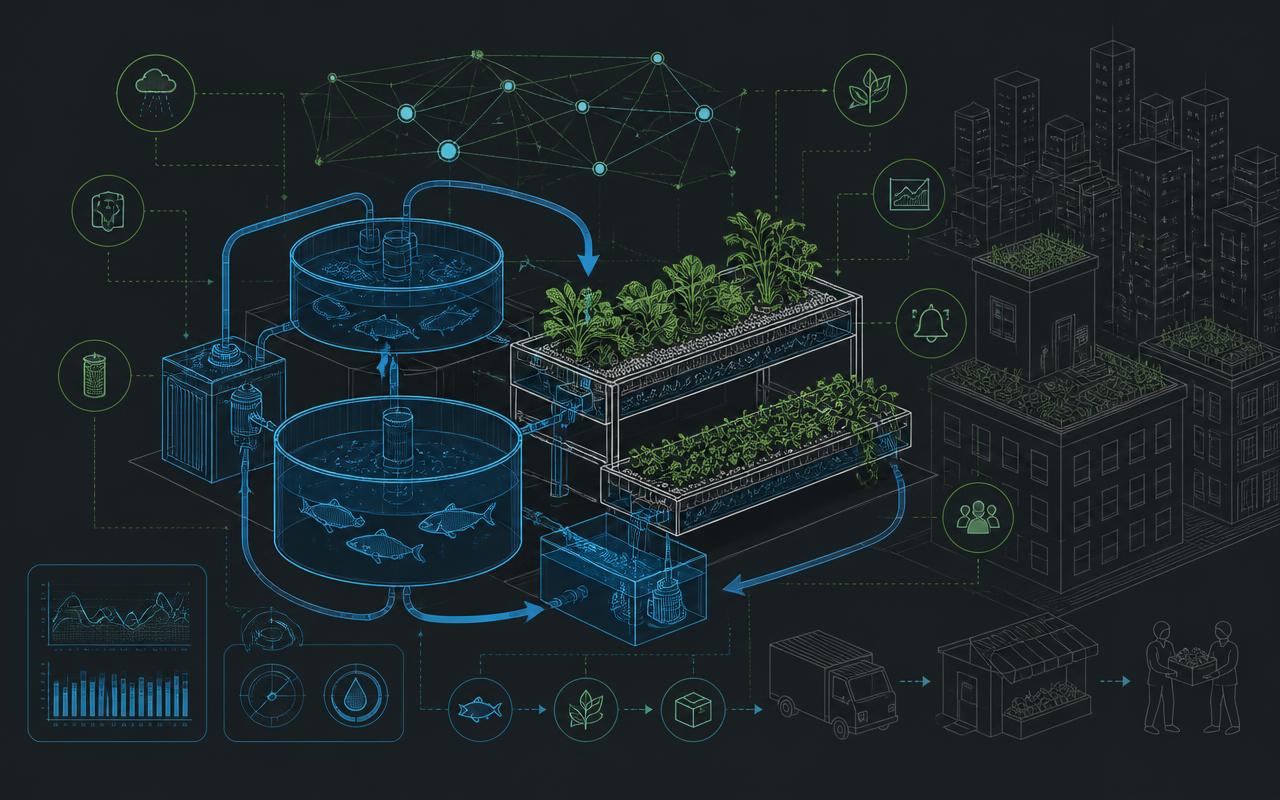
A conceptual Product-Service System model managed by a central social-impact institution, with 16 guidelines across four pillars: Education & Awareness, Design & Strategy, Growing Technologies, and Food Security & Policy.
- Education: agroecological training, food re-education and product processing
- Strategy: centralised management, income mapping, critical spaces, adaptive design and experience tourism
- Growing: open-source guides, community hubs, collective work days, supply hubs, technical assistance as a service and kit sales
- Policy: continuous crop research and articulation with public food procurement, solidarity kitchens and school meals
- 06
Taxonomy and monetisation models
Five PSS categories connect tangible offer, service and revenue — from direct kit sales to urban farms with outsourced management and pure consulting.
- Pure product: kits, pumps and produce — B2B/B2C sales
- Use-oriented: family modules on loan with maintenance and supply subscriptions
- Service-oriented: community and school modules monetised per class or public funding
- Result-oriented: urban farms under volume-based contracts
- Pure service: technical consulting, green logistics and therapeutic horticulture
Impact
Structuring aquaponics as a Product-Service System directly impacts 12 of the UN's 17 SDGs and shows that design methodologies — Double Diamond, value proposition, PSS — solve complex public policy and socio-environmental governance problems, not just interfaces.
Discuss a similar challenge